A specialty pharma manufacturer transitioned copay program administration for its limited distribution pharmacy network to InfinityRx. Based on the manufacturer's prior program data and its own experience with other copay programs, the InfinityRx team recommended adding under-reimbursement support. The share of claims covered by primary insurance, which had held near 10% in the three months before the transition, reached 20.9% in the sixth month on InfinityRx. Three months in, the manufacturer brought copay administration for its retail network onto the same platform.
The challenge: a coverage rate stuck near 10%
The manufacturer offers copay support for two branded products through a limited distribution pharmacy network, alongside a retail network that carries additional products. Before the transition to InfinityRx, a separate copay administrator handled each network.
In the three months before the transition, the share of limited distribution network claims covered by primary insurance stayed between 8.9% and 10.4%. When a claim is covered, the patient's insurer pays most of the drug cost. When a claim is not covered, the manufacturer absorbs that cost through the copay program. Pharmacy reimbursement was the problem.
Depending on the pharmacy benefit manager (PBM) and the pharmacy's contract, what a pharmacy collects from the insurer and the copay together can be near or below what the pharmacy paid for the drug. When the total falls short, the claim is under-reimbursed, and the pharmacy may decide not to fill the prescription. Fewer covered claims are filled, leaving patients with an alternative therapy or no treatment at all.
The program offered no under-reimbursement support, a manufacturer-funded payment that covers the shortfall.
What changed on InfinityRx
With the transition, copay claims for the limited distribution network began adjudicating on InfinityRx Claims Processor® (ICP), the claims adjudication platform InfinityRx owns and operates. The InfinityRx team recommended adding under-reimbursement support, which the program had previously run without, and the support became part of the program on ICP.
When an insured covered claim results in a negative margin, the program applies a dynamic manufacturer-funded adjustment in real time, as the claim adjudicates. The adjustment covers the shortfall and leaves the pharmacy with an economically sustainable margin. The support runs inside the existing copay program, so nothing changes for the patient. The card, the copay, and the steps at the pharmacy counter stay the same.
The manufacturer can now follow results in real time. A dashboard shows each claim and the coverage percentages as claims adjudicate. The manufacturer's team receives a daily claim feed and runs its own analysis without waiting for a quarterly review.
Why the support worked on this platform
Two parts of how the program runs on InfinityRx explain why the support changed what pharmacies did.
The adjustment happens inside the claim
ICP works out the shortfall and applies the adjustment while the copay card claim adjudicates. The pharmacy is made whole on the same transaction, so a pharmacy deciding whether to fill a covered prescription knows the claim will not lose money.
InfinityRx owns the platform the support runs on
Under-reimbursement support is a business rule on ICP. InfinityRx builds, tests, and changes its business rules in-house, with no dependency on a third-party vendor.
The results
Within six months of the transition, the share of limited distribution network claims covered by primary insurance went from about one in ten to more than one in five.
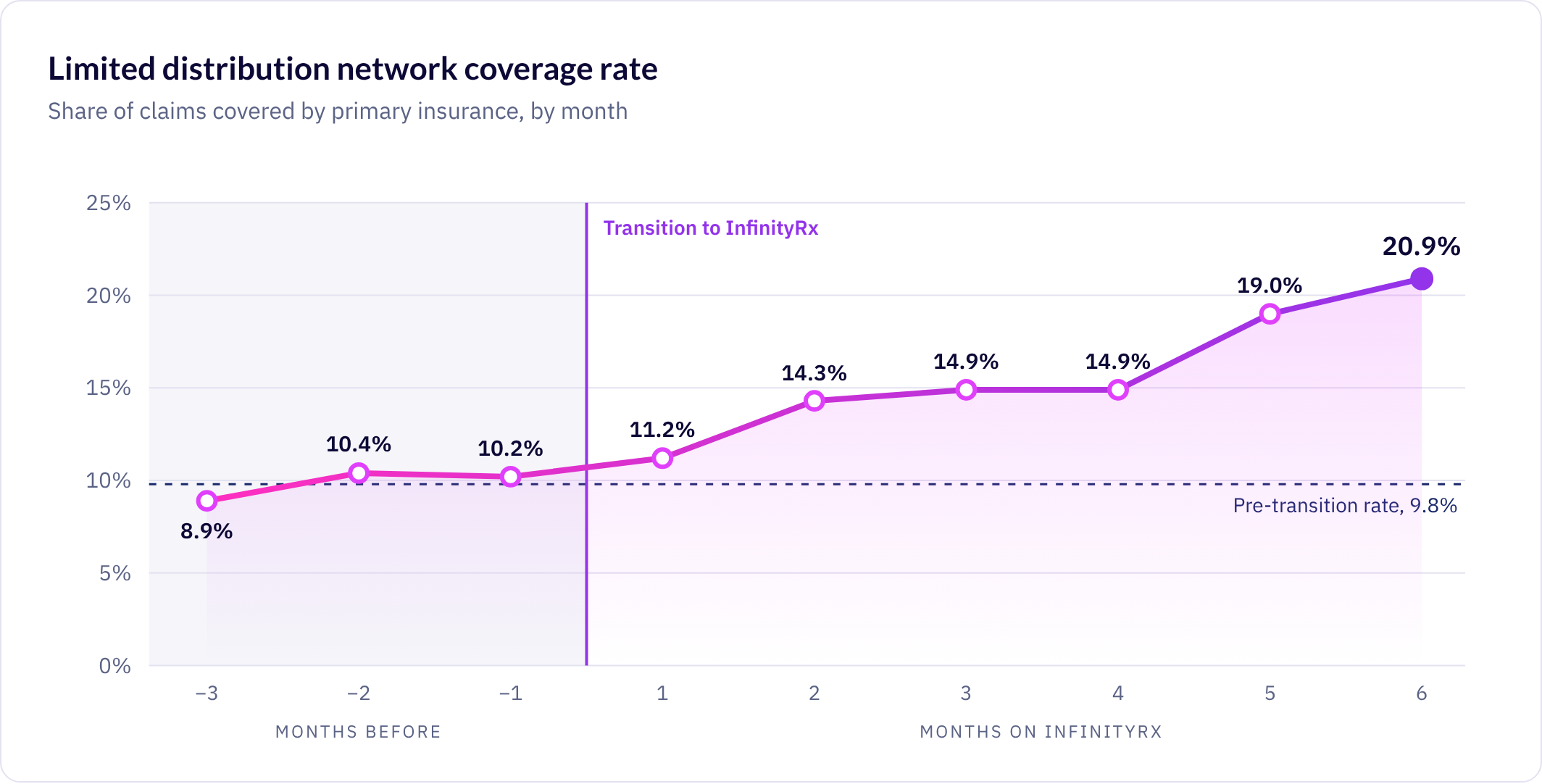
- The program rate more than doubled. Coverage was 9.8% across the three months before the transition and reached 20.9% in the sixth month on InfinityRx, a gain of 11.1 points.
- The change started with the transition. The rate stayed between 8.9% and 10.4% in the three months before. In the first month on InfinityRx, the rate was 11.2%, above each of those three months. The rate reached 14.9% by the third month.
- The gain was broad. From the first month on InfinityRx to the sixth, both products nearly doubled their rate, and all five NDCs improved, with gains from 7.7 to 18.0 points.
- The gain reached the highest-volume NDC. The NDC that carries about half of the program's claims doubled its coverage rate over the same six months.
What the manufacturer did next
Three months after the limited distribution network transition, the manufacturer brought copay administration for its entire retail network, which carries additional products, onto the same platform. The early limited distribution network results prompted the decision, and by then the manufacturer's team had a full quarter of results to review. The coverage rate had risen from 9.8% before the transition to 14.9% in the third month, and the manufacturer could follow that change in the dashboard and the daily claim feed.
Both networks now run on one adjudication platform under one copay card group. Running a program across separate administrators means reconciling separate data and keeping the same business rules aligned in more than one system. With both networks on one platform, the claims data sits in one place.
One card group also means standard reporting combines the two networks, and the manufacturer wanted to keep measuring its limited distribution network pharmacies separately. InfinityRx pulled the limited distribution network claims into a separate analysis, with coverage broken out by product and by NDC. The figures in this case study for the first six months on InfinityRx come from that analysis.
Coverage rate is the share of net paid copay card claims covered by the patient's primary insurance. Figures on InfinityRx are based on program data for the limited distribution network, across more than 50,000 net paid claims in the first six months. Figures for the three months before the transition are calculated from claim counts supplied by the manufacturer for the same two products.
See what under-reimbursement is doing to your coverage rate.
Request a program assessment